
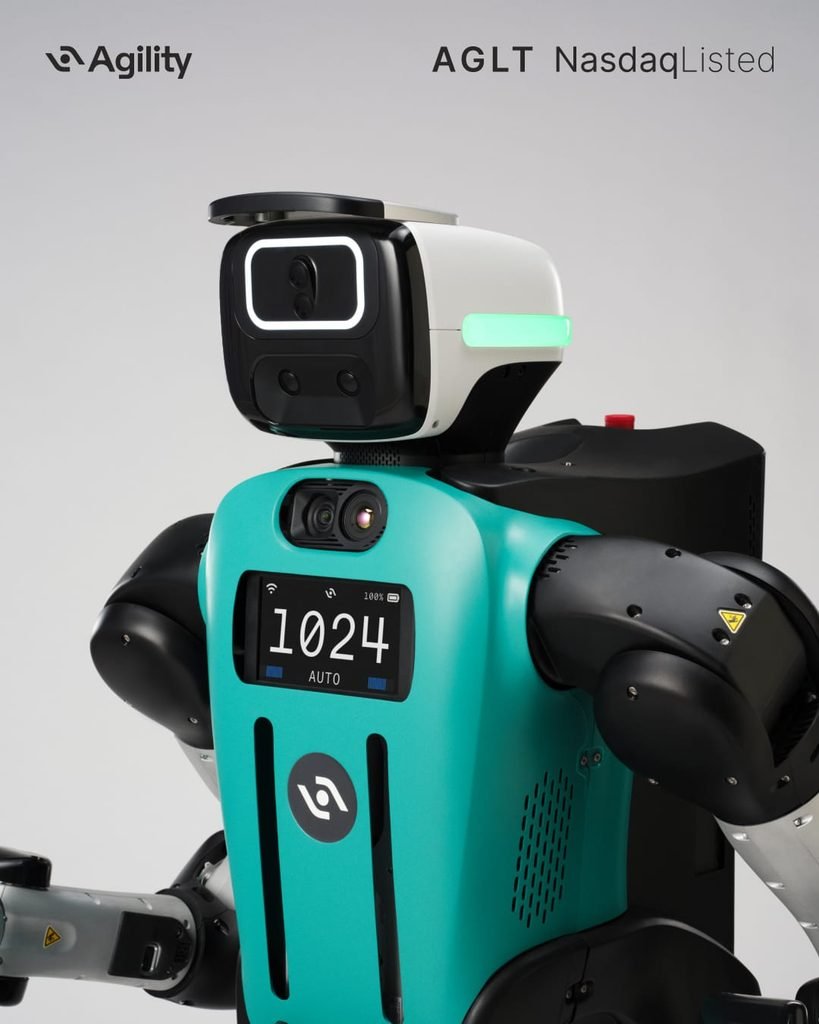
Image Credits: Agility
A year ago, Figure AI CEO Brett Adcock made a prediction on social media about how soon the company would be bankrupt. He was referring to the taunts from rival company Agility. Instead of going public, the company is going through a reverse merger. It will then raise $465 million from investors and a private equity fund.
Before the company’s stock market debut, Peggy Johnson, the company’s CEO, told TechCrunch that there weren’t a lot of dancing and backflipping robots made by Agility. Instead, the company focused on developing robots that are repetitive.
The company was founded in 2015 by a team of researchers from Oregon State University. They made a significant breakthrough in developing a robot that can walk on two legs. Since then, the company has been focused on deploying its robots in industrial settings. It has nine customers, including GXO, Toyota, and Schaeffler. The company’s Digits are used to move heavy objects, such as boxes, at a GXO facility.
Compared to the other companies that made humanoid robots, such as Tesla and Boston Dynamics, Agility’s Digit is relatively slow. However, it’s still working, and it earned money during the first six months of 2026. The company lost over $362 million during this period, which means that it’s still very close to successfully deploying its new capital.
The good news is that the company has signed several contracts with 30 customers for its new Digit 5 robot. The new model can work around people, which is a huge step up from its previous model, which was only able to perform in isolated work cells. Johnson said that the company’s decision to go public was influenced by the contract with 30 customers.
According to Johnson, Digit 5 will have to meet various criteria, such as accuracy, throughput, and uptime, in order to close deals. Although the company hasn’t released the details of its upcoming robot, Digit 5 will most likely be shown at CES in 2027. The company claims that a robot could save a company around $100,000 annually if it’s purchased outright.
The future of unit economics will depend on the capabilities of Digit 5. For instance, if Digit 5 can perform tasks consistently and without stopping for recharging or maintenance, it could be a game-changer. Johnson said that the company wants to give the robot a job that’s repetitive, such as moving a 50-pound object.
One of the most important questions that Agility will have to answer is how quickly it can improve the capabilities of its Digit 5 robot in order to attract more customers. During the first six months, the company was able to sign four new customers. Despite being able to pick up heavy loads with a 98 percent accuracy, the robot still lacks the ability to perform complex manipulation tasks.
It’s still not clear if generative AI techniques can help robots with dexterity that would allow them to carry out various tasks. Although training systems based on teleoperation data have led to some improvements, they still lack reliable general autonomy.
Due to the lack of data on the movements of Digit, many people are trying to simulate the robot’s movements using various techniques. However, according to Johnson, the company has the necessary resources to train the robot in order to improve its capabilities. For instance, it has over 65,000 hours of real-world operational data.
Although the company was able to raise capital through a SPAC transaction, Johnson noted that it wasn’t enough to allow the company to be self sustaining. She said that the company would continue to listen to its customers and develop products that meet their needs. She also said that the company would continue to increase its production capacity.
During the opening of the company’s R&D facility in Fremont, Johnathan Hurst, the company’s CTO, said that the company’s robots could start by picking up the bins and the tote bags. Then, they can start working on cardboard. He said that the company could eventually have a hundred million robots working on various tasks.